

January 06, 2009
20% discount off our signature
Whole Body MOT
Normal Value £100
February only price £80
To give you a bit of a helping hand this year we are happy to offer our Whole Body MOT at the discounted rate of £80. We understand that you are very motivated to achieve your exercise goals and might just need the correct guidance to help you to achieve them.
The Whole Body MOT is a specifically design range of tests and assessments used to paint a three dimensional picture of your body. We take your body apart to see what is working, what is not working, what is flexible, what is not flexible and therefore gain a complete understanding of what stage of conditioning you are at.
We will also be looking at how your body moves in a three dimensional environment and if there are any restrictions, weaknesses, or dominant movement patterns. These specific movements can be broken down into how you squat, lunge, bend, twist, push and pull.
Also with our Whole Body MOT we will be measuring your spinal curvature, assessing muscle sequencing patterns, looking at the strength of key prime movers and their associated stabilising muscles along with the key core muscles in a stabilising and movement function.
In very simple terms, we will be taking your body apart to see how efficiently everything is working! Then we can start to process of putting it all back together again…
But don't just take our word for it:
"... Lyndon knew more about my body in an hour and a half than I ever did"
posted by Lyndon Littlefair at 12:16 PM

August 01, 2008
Have a Ball in The Park
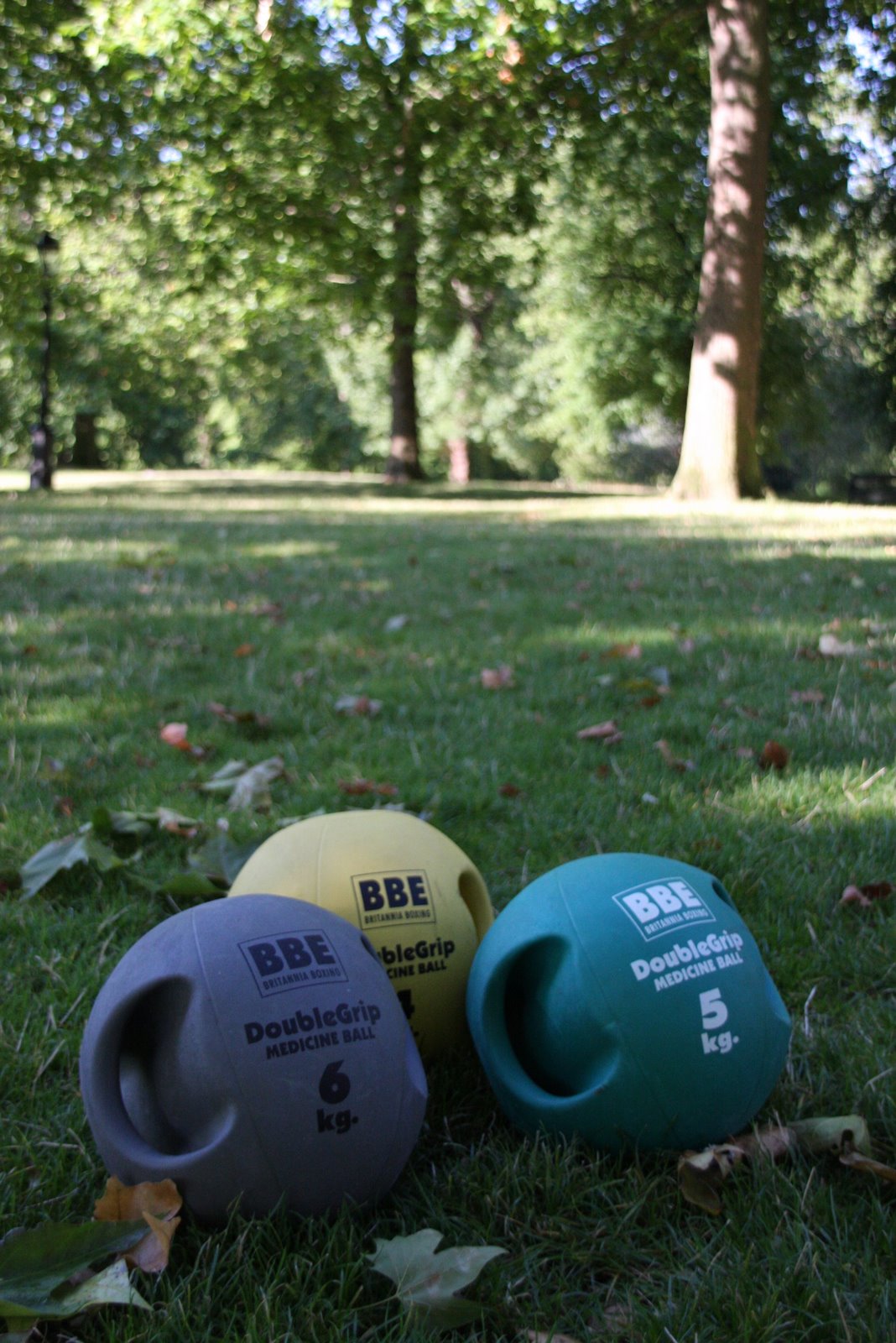
How would you like to improve fitness, strength, flexibility and power and have fun while doing it?
After popular demand, Equilibrium is starting up a Small Group Personal Training session in Hyde Park. We will be using medicine balls as the main component to our workouts. We will be integrating bodyweight exercises and whole body movement patterns to achieve a complete body workout.
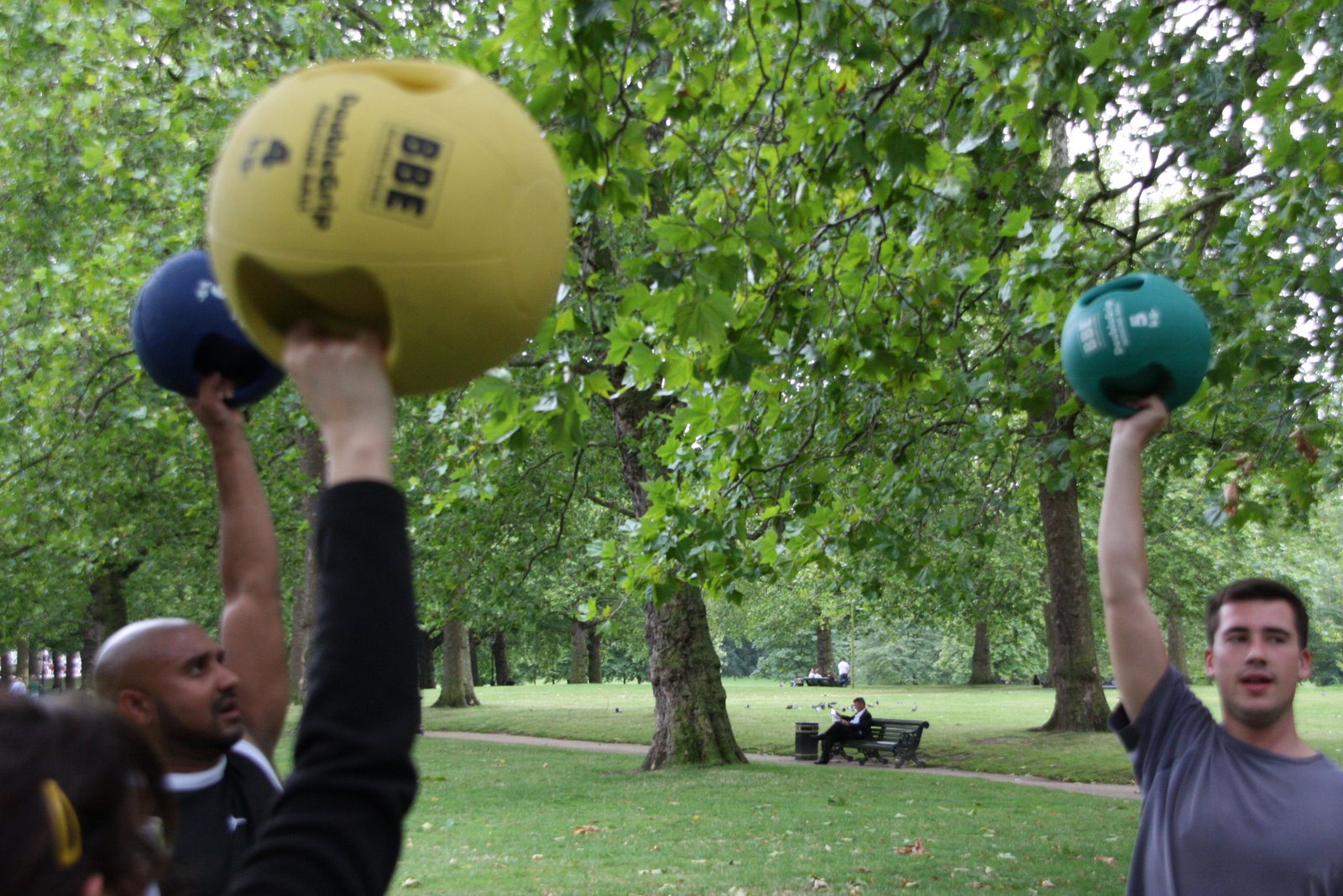
If you think a good workout is a few bicep curls or tricep extensions, then I’m sorry, but this session may not be for you. However, if you want a whole body workout integrating every muscle in the body to kick-start your metabolism and burn more bodyfat when sitting down, then this workout could be for you!
When:
The session will take place every Monday at 6.15pm-7.15pm*.
*Other session times will be added as demanded.
Where:
Hyde Park, meeting at the band stand just near Hyde Park Corner.
Closest Tubes:
Hyde Park Corner, Green Park, Marble Arch
Cost:
£15 per session*
* Minimum of 5 sessions
* To try it out before you commit to 5 session, we run a taster session for £15. Once you have tried it out and you have decided that it is for you, then we require the 5 session minimum package.
There is a maximum of 8 people per session, so advanced booking is essential. This is not a mass bootcamp situation, this is Small Group Personal Training!
Contact Lyndon Littlefair at Equilibrium to book your first session and secure your place, or phone him direct on 07957 152 245.
There is a maximum of 8 people per session, so advanced booking is essential. This is not a mass bootcamp situation, this is Small Group Personal Training!
Contact Lyndon Littlefair at Equilibrium to book your first session and secure your place, or phone him direct on 07957 152 245.
Labels: group training, medicine balls, outdoor training, personal training
posted by Lyndon Littlefair at 7:06 PM
July 28, 2008
Medicine Balls Have Evolved!

When I tell people that I use Medicine Balls in my training, most people give me a very strange look. They either haven’t got a clue about what I am talking about, or they have a nightmare vision of something out of a Rocky movie. When you talk about Medicine Balls, most people think of the big old leather bricks that their PE teacher used to throw at them if they did something wrong. They also think of them as a very outdated, backward way of working out. In this 21st century of high tech vibrating miracle workers, how could one of these big old leather bricks be any use?
Fortunately for all of us, these big old leather bricks have evolved. They are now made from rubber to help you to grip them. They are no longer the size of a small watermelon (well, not all anyway). And some even have some funky handles so you can do all sorts of exercises with them.
The medicine ball is a useful tool to incorporate into any training programme. It is a highly functional tool that can be used to create, and train, in a three dimensional training environment. Now you are probably wondering what I mean by a three dimensional training environment. Let me explain.
With all movement of the body, you can break it down into three basic planes of movement. The first one is called the sagittal plane. If you were to run a plane of glass straight down your body from front to back, dividing you into left and right, this is the sagittal plane. Movements associated with this are walking straight ahead, bending forward to touch your toes or a leg extension machine at the gym.
The next plane is called the frontal plane. If you took that same plane of glass (not literally I hope) and ran it vertically through your body from side to side, dividing you into front and back, this is the frontal plane. Movements in this plane of movement would include bending to the side and side-stepping.
The last but not least of the planes of movement is called the transverse plane. This is often called the rotational plane as it makes up all of the movements where you are rotating your body. If you had that same plane of glass and put it horizontally through your body to divide it into top and bottom, you then have the transverse plane.
If you walk into you gym tomorrow and have a look at all of the machine based exercises, they all have one thing in common…they nearly all work in the sagittal plane of movement. Think about it, the chest press, leg press, seated rows, leg extension and the leg curl all work through this one plane of movement. Also if we have a look at how we traditionally train the abdominals you will find a similar thing happening. I’m sure you could think of at least 5 different variations of crunch or reverse crunch type of movement. Again this is just training the abdominal muscles in the sagittal plane.
Now do you think that the human body was designed to work through one plane of movement, or do you think it was designed to move, twist, bend, lunge, squat, pull and push?
If you thought NO, then you are 100% correct! We were designed to move and work through all of these different planes of movement. So to gain most out of your exercise programme and training, we need to move and strengthen through all of these planes.
That is where medicine balls come in. Unlike fixed axis gym machines which guide your arms exactly where they need to go, you actually have to control the movement of the medicine ball. You also can move your body in all of these three planes of movement by combining different exercises and movement patterns. “Damn, does that mean it is harder?” I prefer to use the expressions ‘more effective’ and ‘more beneficial’!
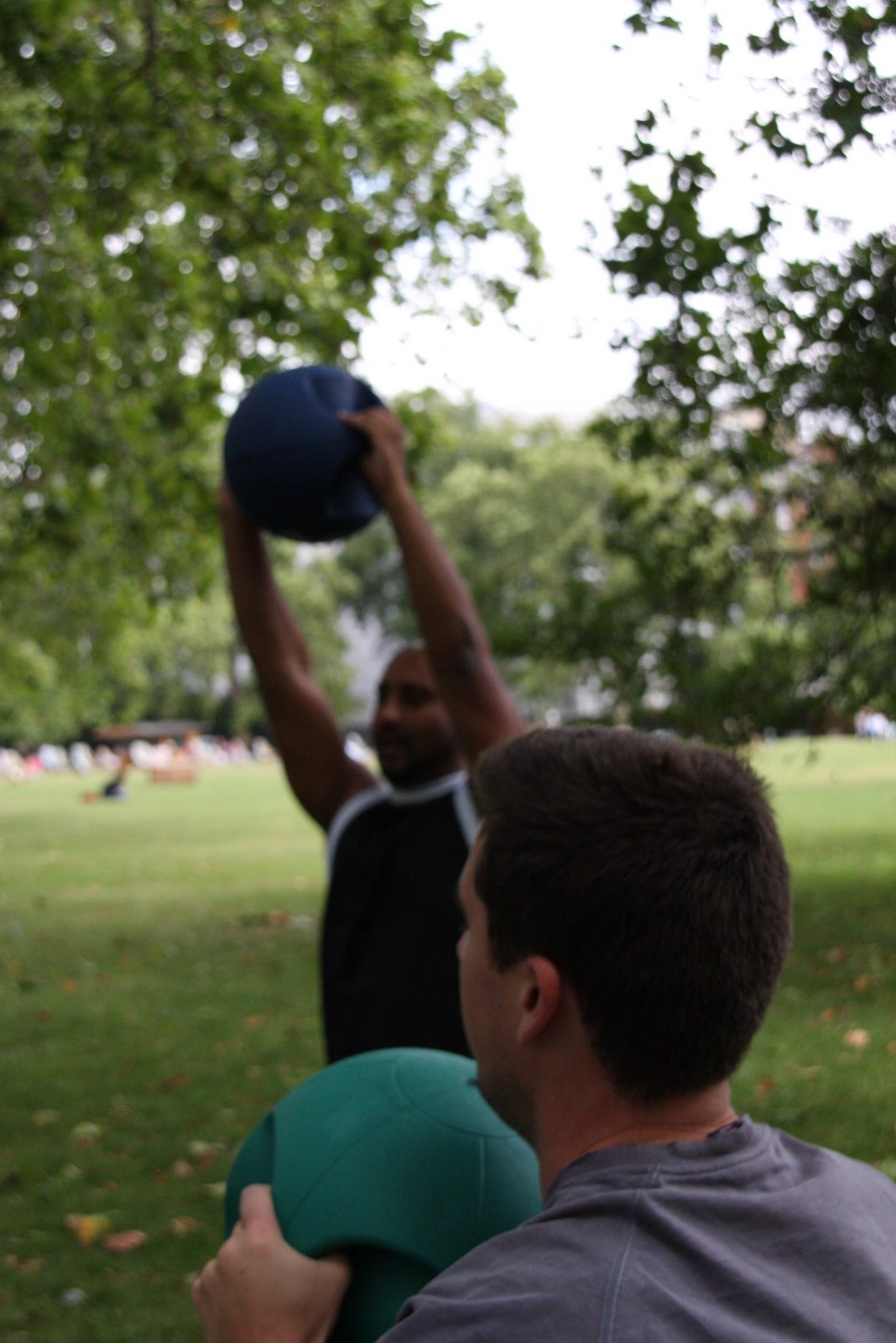
Ok, we know that medicine balls are good for a multi plane three dimensional workout. But what else?
In a medicine ball workout, you are actually using a lot more muscle groups at the one time. That is, you will be working muscles to move the ball (the prime movers). You will be working the muscles that help stabilise the joints around the movement (the stabilisers). You will also be using muscles that help to stop any unwanted movements (neutralisers). So all in all, there are a lot more muscle being involved in the whole process. This means that the nervous system has to do a lot more work also. All of this means that you get a lot of training effect in a relatively short amount of time. Because you are using all of these muscles at the same time, you increase your ability to burn bodyfat by increasing your metabolic rate. And that’s not a bad thing is it?
The medicine balls are also very versatile. This means that you can combine several movements together in the one exercise. For example, instead of doing a leg press, you could perform a lunge with a rotation. So instead of just working your legs, you have worked your legs, your abs, your shoulders and your arms. Harder…yes, but more effective and more beneficial…YES!
We talked about doing crunches before in that one plane of movement. Medicine balls are actually better at targeting your abdominals than any type of floor based crunch exercise. The reason for this is that when you are doing a normal floor based crunch you are only really working the top portion of your rectus abdominus (that’s the six pack muscle by the way). You are not targeting the lower portion of this muscle, your internally and external obliques (the ones at your sides) or the deep transverse abdominus (the main core muscle everyone keeps talking about). If you just sit there if front of your computer and twist and turn and bend and extend, you will get a better idea of how much movement you have through your abdominals and why one simple forward bend in the sagittal plane is limited in way abs are traditionally trained. That is where medicine training can come in. You have the ability to load your abdominals in multiple planes of movement to get a strong, flat and functionally sound set of abdominal muscles.
The exercises involved with using the medicine balls are actually a whole heap of fun. It actually removes you from the traditional ‘gym’ environment and makes you realise that you don’t have to pound that treadmill to gets results.
Medicine ball training is appropriate to all levels of age and ability. From children to older people, from the office worker to the highly conditioned athlete, they are a highly versatile tool which can provide a whole heap of training benefits.
Equilibrium are holding medicine ball training in Hyde Park for small groups. To take your training to a whole new three dimensional world in a fun and energetic environment contact Lyndon Littlefair.
Click here for an updated schedule!
posted by Lyndon Littlefair at 11:07 AM